
Why Can't Christians Define "Sin"?
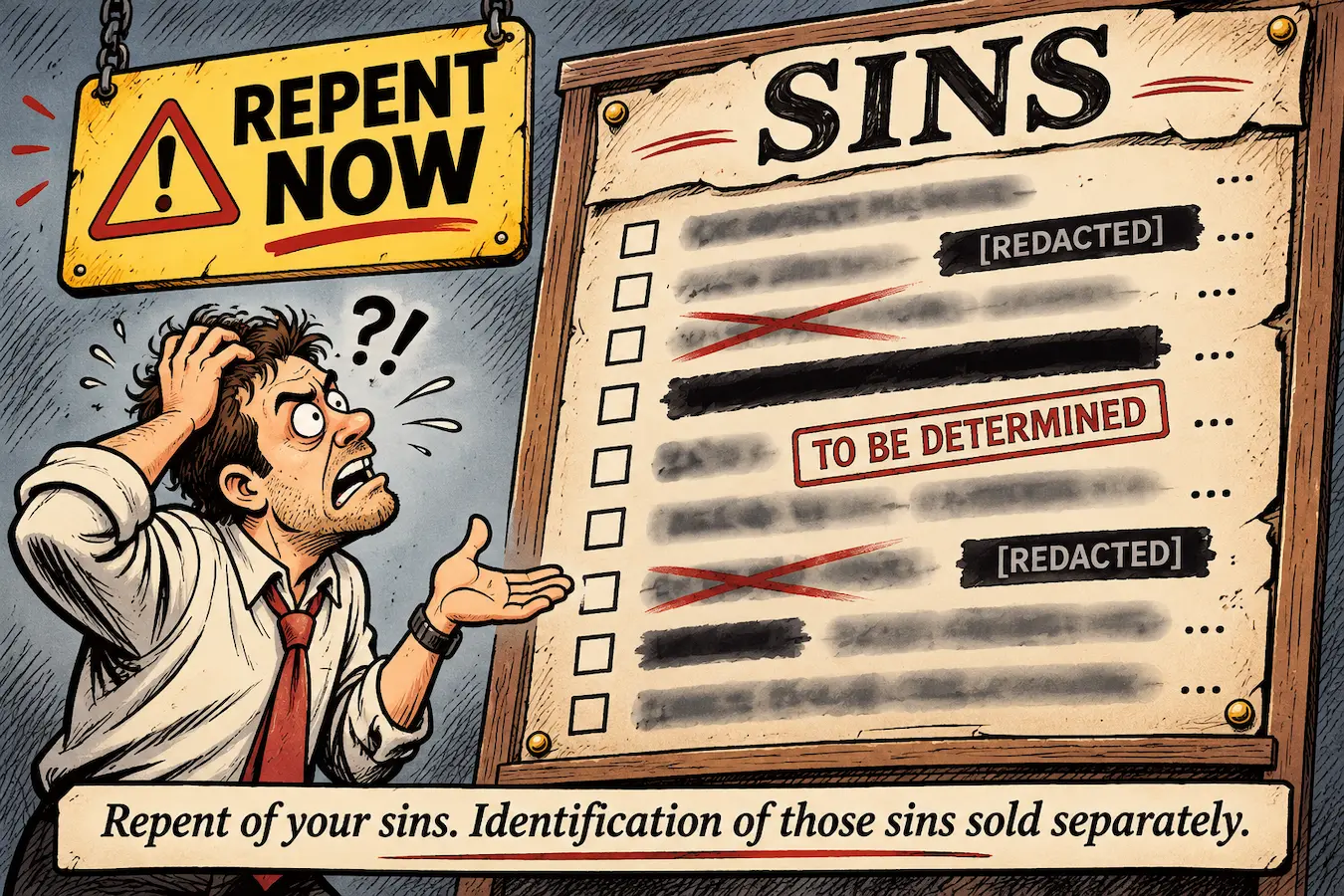
Christianity makes sin the reason humanity needs salvation. But the Bible provides contradictory rules for identifying it. How can believers repent of sins they cannot define?
The Argument in a Nutshell
(scroll down for a more complete treatment with biblical references)
Christianity is built around sin. Sin is why humanity supposedly needs salvation, and repentance is the first step toward receiving it.
There's just one rather important problem: the Bible never provides a consistent way to determine what constitutes a sin.
Here's the problem in a nutshell:
- Sin is defined as breaking God's law (1 John 3:4; Romans 7:7). Fair enough. But which law? Jesus says every commandment remains binding (Matthew 5:18–19), while Paul says Christians are no longer under the law (Romans 6:14).
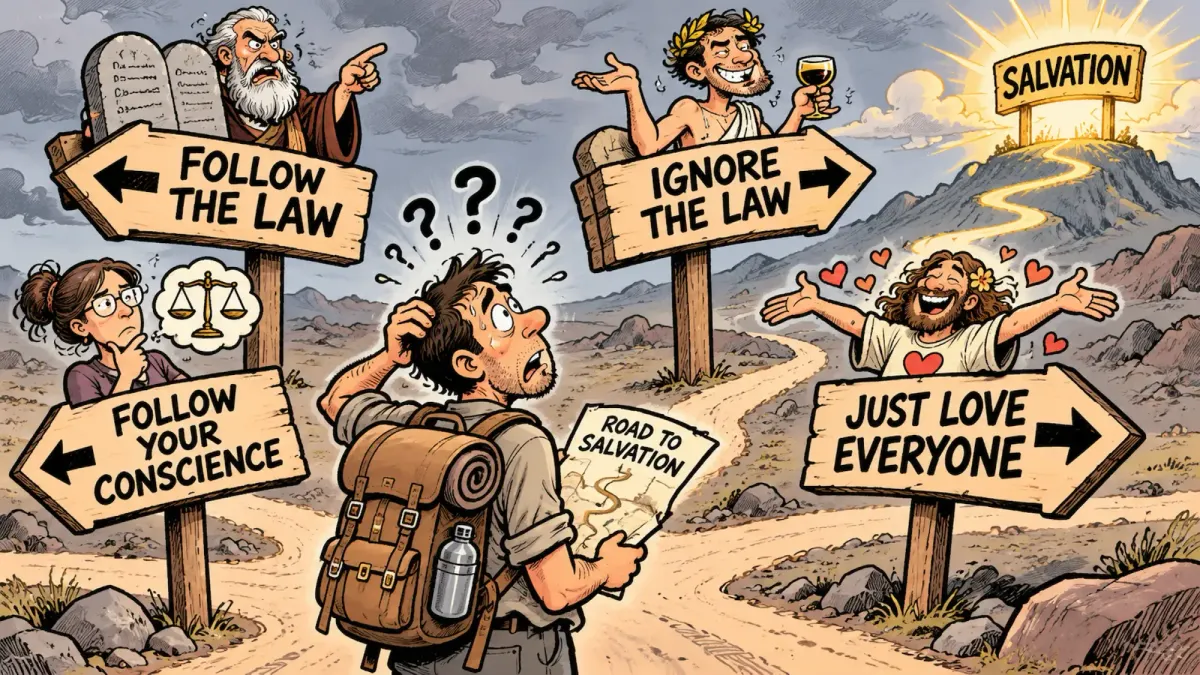
- The Bible offers several competing standards for identifying sin. Obey the law. Love your neighbor. Follow your conscience. Avoid causing others to stumble. And don't forget the assorted lists of forbidden behaviors. Nowhere does Scripture clearly explain how to reconcile these standards when they conflict.
- Christians decide which biblical laws still apply. The familiar division into moral, civil, and ceremonial law is a theological construction, not a classification explicitly established in Scripture.
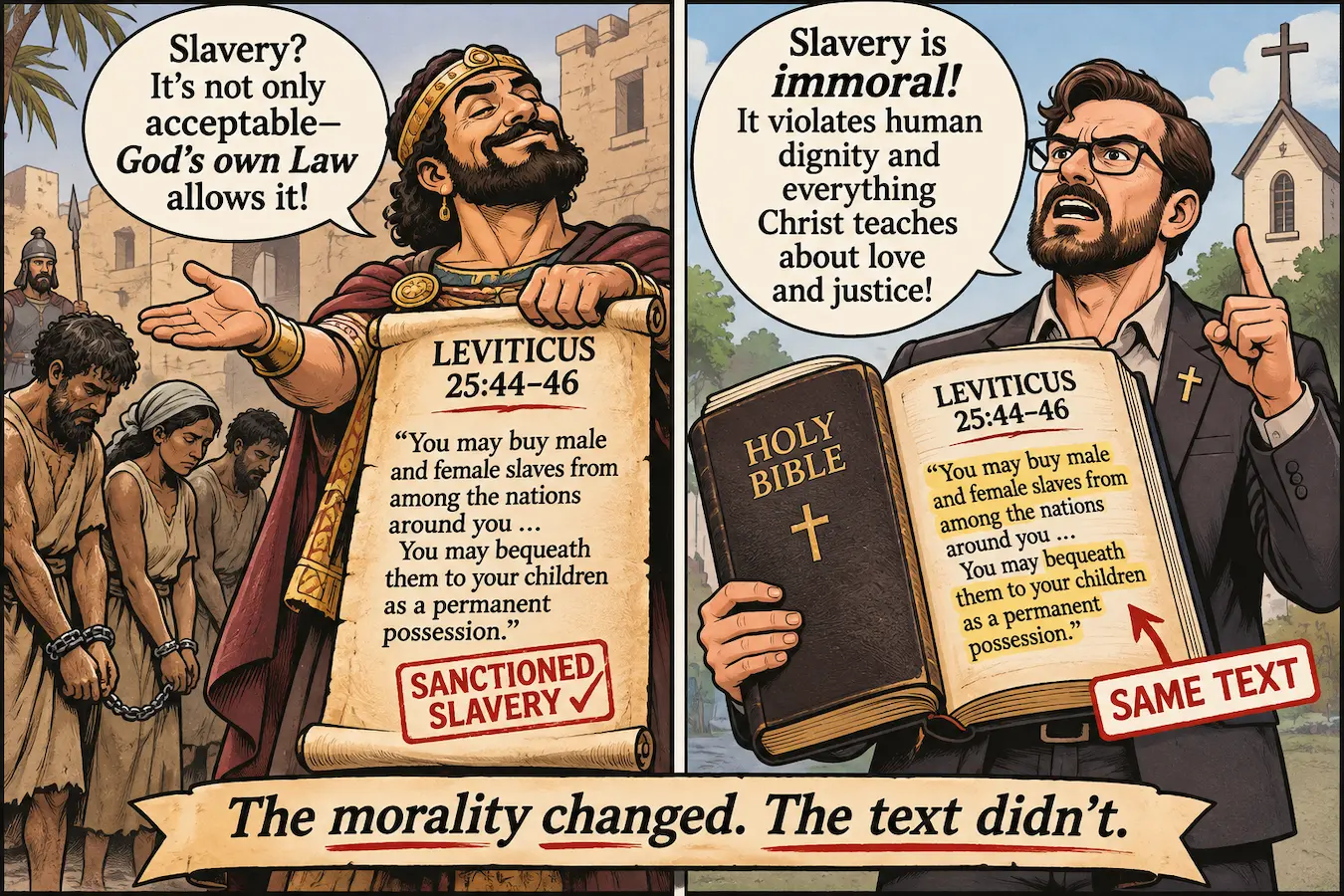
- Slavery exposes the problem. Biblical law explicitly permits owning foreigners as permanent property (Leviticus 25:44–46). The New Testament instructs slaves to obey their masters. Yet modern Christians overwhelmingly condemn slavery. The moral judgment has changed, while the biblical passages remain the same.
- The Bible acknowledges that people can sin without knowing it (Leviticus 5:17). If you don't know an action is sinful, how are you supposed to repent of it?
- Christians routinely disregard explicit New Testament commands. Prohibitions against swearing oaths, instructions about women's head coverings, restrictions on jewelry, and the prohibition against consuming blood are commonly treated as optional or obsolete. Who decides which commands count?
- Paul says love fulfills the law (Romans 13:10). But he also condemns idolatry, covetousness, and other behaviors that do not necessarily harm one's neighbor. If avoiding harm fulfills the law, why do these prohibitions remain?
- Paul rejects the authority of the law while issuing new lists of forbidden behavior. If violating those lists constitutes sin, how are they functionally different from the law he says Christians are no longer under?
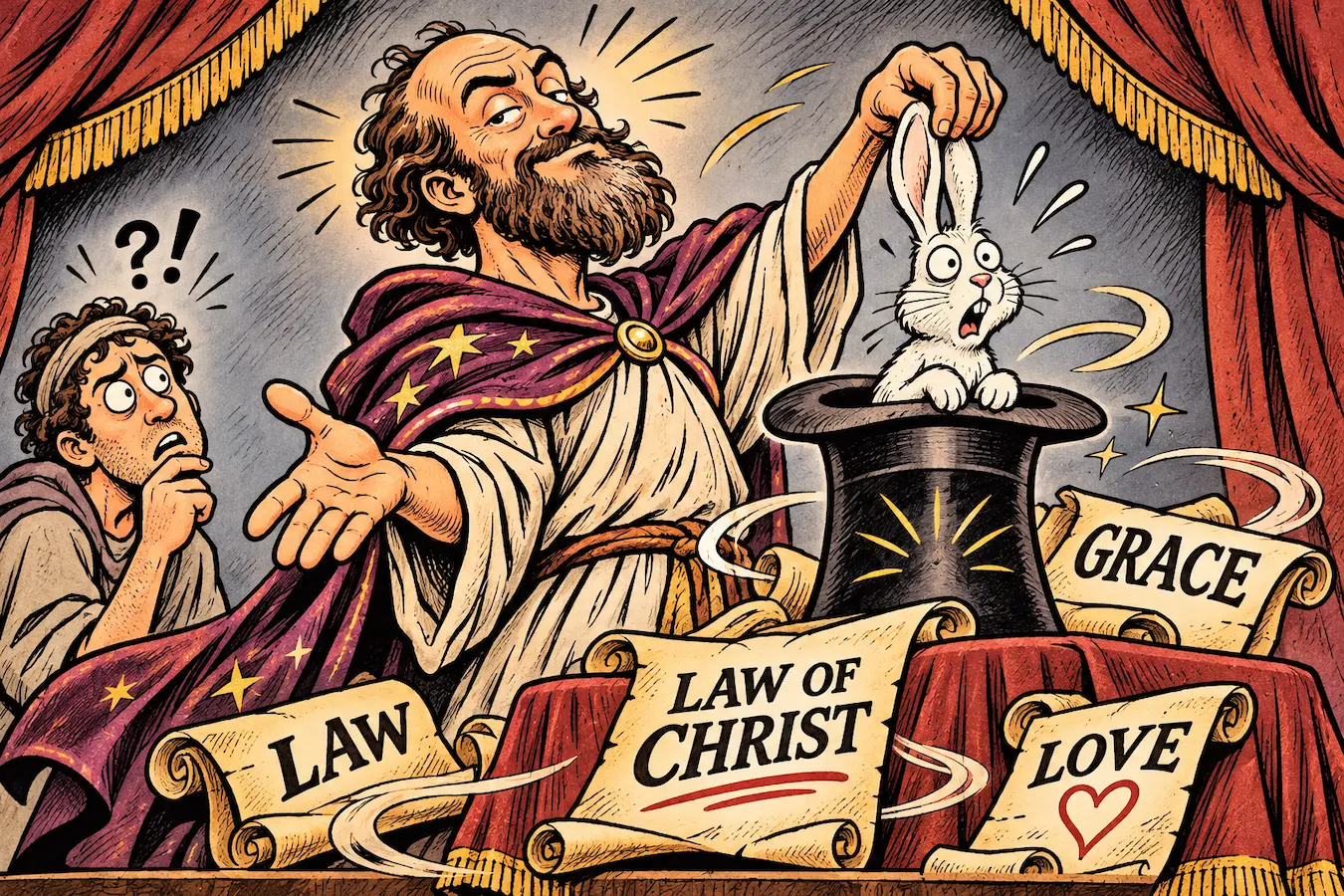
- Paul repeatedly changes what he means by law. Sometimes it refers to Mosaic commandments, sometimes to a spiritual principle, and sometimes to the law of Christ. He never provides a clear procedure for deciding which ancient commandments remain binding.
- Repentance becomes a theological guessing game. A person may sincerely repent of everything they recognize as sinful while continuing to commit offenses they don't even know exist.
And that's the fundamental problem.
Christianity tells people that sin separates them from God, that repentance is essential, and that salvation depends on resolving the problem of sin.
But it never supplies a consistent standard for identifying the very thing people are supposed to repent of.
Of all subjects, sin is the one that should have been explained the most thoroughly.
The Full Argument
The Question
Christianity is, at bottom, a religion about sin. Christian doctrine holds that the first step of salvation is repentance, which means a turning away from sinful acts and an expression of regret for past sins. That isn’t a later theological add-on. It’s pretty obvious that repentance is the primary step of salvation in the New Testament. The first Christian message, the one that directly answered how to be saved, put repentance first. When the crowd at Pentecost asked Peter what they had to do, his first word was “Repent” (Acts 2:38). Paul told the Athenians that God “now commandeth all men every where to repent” (Acts 17:30).
So here’s the problem. How can a Christian turn away from sinful acts when there is no biblical way to define what a sinful act is? How do you turn away from something if you don’t know what it is?
I went looking for a rubric in the Bible by which I could evaluate any potential action and determine whether it is sinful or not. I didn’t want apologetics and theology. I wanted scripture. I couldn’t find one, because there isn’t one. What I found instead was a pile of contrary and ambiguous statements about sin, and, from the man who did more than anyone to shape Christian doctrine, vague language.
What Scripture Actually Offers
The Bible doesn’t give one test for sin. It gives several, and they don’t line up.
The closest thing to a definition comes from John: “sin is the transgression of the law” (1 John 3:4). Paul agrees that “I had not known sin, but by the law” (Romans 7:7), and that “where no law is, there is no transgression” (Romans 4:15). Fine. Which law, though?
That’s where the texts start arguing with each other. Jesus says not one jot or tittle will pass from the law, and that anyone who breaks even the least commandment will be least in the kingdom (Matthew 5:18–19). James says that if you stumble on one point, you’re guilty of all of it (James 2:10). Then Paul tells his readers that holy days and diet are up to the individual (Romans 14:5–6, Colossians 2:16), that they’re “no longer under a schoolmaster” (Galatians 3:25), and that the law of commandments was “abolished in his flesh” (Ephesians 2:15). Hebrews says the old covenant is “ready to vanish away” (Hebrews 8:13). So which is it?
There are other tests floating around, too. Love God and love your neighbor, because “on these two commandments hang all the law and the prophets” (Matthew 22:40). Don’t do anything that trips up a weaker believer, even if it’s otherwise allowed (1 Corinthians 8:9–13). And then there are the vice lists in Galatians 5, 1 Corinthians 6, and Romans 1.
The conscience test makes things worse. “Whatsoever is not of faith is sin” (Romans 14:23). So an act that is explicitly allowed by God himself becomes a sin if a person has a conviction against it and does it anyway. But conviction isn’t a spiritual thing. It’s a mental thing. It’s based on what you have been taught is right and wrong. That’s what conscience is, and most of our moral sense is culturally derived. So a forbidden act can’t be made righteous, but a righteous act can be made sinful, and we’re right back where we started: is there a way to determine what acts are forbidden or allowed?
What you won’t find anywhere is instructions for putting all this together. Which test outranks which? Which commands still count? Christians usually handle it by splitting the law into moral, civil, and ceremonial parts and keeping only the moral part. But the tripartite division of the law is theological. It isn’t even hinted at in the scriptures themselves.
Test Case: Is Slavery a Sin, or Not?
If you want to see how well the biblical tests actually work, try them on slavery.
The explicit commands allow it. Israelites could buy slaves from the nations around them, and “they shall be your possession... ye shall take them as an inheritance for your children... they shall be your bondmen for ever” (Leviticus 25:44–46). If a master beat a slave so badly that the slave died on the spot, the master was punished. If the slave hung on for a day or two first, there was no penalty, “for he is his money” (Exodus 21:20–21).
Whatever protections the law offered were for Hebrews, not foreigners. Kidnapping a man and selling him was a capital crime, but Deuteronomy 24:7 spells out that it means kidnapping “any of his brethren of the children of Israel.” Exodus 21:16 just says “a man,” but the word is understood in context. We are told many times about the Hebrews taking slaves after capturing a city. Everyone knew it was okay to take slaves from foreign lands, so stealing a man meant kidnapping a Hebrew. The focal point of the law was Hebrew society, and it’s difficult to understand how a Hebrew would be executed for harming a gentile when the history of Israel was full of massacres and genocide against gentiles. When the northern kingdom hauled off captives from Judah to make them slaves, the prophet Oded protested because they were “your brethren” (2 Chronicles 28:8–11), not because slavery was wrong. And the rule against handing an escaped slave back to his master (Deuteronomy 23:15–16) applies to slaves held by gentiles in foreign lands, not to slaves held by Hebrews.
The New Testament leaves all of this in place. Slaves are told to obey their masters “with fear and trembling” (Ephesians 6:5), even the harsh ones (1 Peter 2:18). Masters are told to treat their slaves fairly, but nobody is ever told to set them free. Paul sends Onesimus back to his master, Philemon.
The Golden Rule is the only test that cuts against any of this, and only if you decide it outranks the specific regulations. The Bible never makes that call. The same book that says “love thy neighbour as thyself” (Leviticus 19:18) authorizes owning human beings forever, six chapters later. Slavery is permitted in both testaments, so it passes every test the Bible gives.
Slavery was once universally held as fine and had God’s seal of approval. Now it is held almost universally to be immoral. That shift didn’t come from the Bible. There is no way to prove slavery is a sin biblically.
What About the Sin You Don’t Know About?
There are many things we do today that were not imagined during the writing of the Bible. Take watching television. There are Christians today who believe it is sinful. It can’t be in the Bible, so there is no explicit command. They point to “I will set no wicked thing before mine eyes” (Psalm 101:3), but the verse doesn’t say what’s wicked. The reader decides that first and quotes the verse afterward. And the fact that some acts are forbidden does not mean that all forbidden acts are contained in the Bible.
The Bible even admits that people sin without knowing it. “Though he wist it not, yet is he guilty” (Leviticus 5:17). “Who can understand his errors? cleanse thou me from secret faults” (Psalm 19:12). So things that every Christian does every day could be sins. It is not reasonable that a religion that is literally about sin would leave it so nebulous that people can accidentally sin without knowing it.
In the same way that slavery went from God-approved to immoral, what other actions do we do daily with no guilt that might be considered a sin by God, but we don’t know, because there is no way to determine it from the Bible? It works in reverse, too. Christians blow past explicit New Testament commands all the time. Jesus says swear not at all (Matthew 5:34), and so does James (James 5:12), yet Christians swear oaths in courtrooms every day. Paul condemns believers suing each other (1 Corinthians 6:1–7), tells women to cover their heads when they pray (1 Corinthians 11:5–6), and forbids gold, pearls, and braided hair (1 Timothy 2:9). The Jerusalem council told gentile converts to abstain from blood and from things strangled (Acts 15:29). Most Christians ignore every one of these. The commands their culture finds odd get dropped, and the ones it still likes get kept.
Now think about how this fits with salvation. Orthodox Christian doctrine holds that God’s holy nature makes it impossible for sin to exist alongside him. It’s like liquid water existing at 200 degrees Celsius: it just doesn’t work. Sin doesn’t come into contact with God’s fellowship. “What communion hath light with darkness?” (2 Corinthians 6:14). The blood of the sacrifice is not automatically applied to all sinners, or else we wouldn’t need to repent or believe. The application comes at belief combined with repentance.
If a person believes and repents of the sins they know, the blood is applied. But the next day they go out and commit another sin they are ignorant of, and the blood is not applied, because there was no act of repentance regarding that. Can a man plead guilty to a crime that hasn’t been committed yet? Can you truly give a heartfelt apology to your wife for cheating on her when you haven’t done so? The idea of past actions is implicit in the idea of forgiveness. Sin is the thing that pollutes a person and condemns them to hell, and if sin is polluting, it doesn’t matter whether the person knows they are sinning or not. If you do not know what constitutes a sin, you can continue polluting your soul without realizing it.
The idea that sin is automatically covered without any action or even knowledge of the sinner is not borne out in scripture. The closest the New Testament comes is 1 John 1:7, which says the blood “cleanseth us from all sin” if “we walk in the light.” And what does walking in the light mean? John never says. So the remedy for a sin nobody defined depends on a condition nobody defined either.
Paul and the Law
If anybody should have spelled out what sin is, it was Paul. He’s the one who told Christians they were “not under the law, but under grace” (Romans 6:14). The sacrifice of Jesus for the sins of the world and the elimination of the law created some syncing issues. Sin is the violation of the law. But if the law is abolished (or fulfilled), then sin doesn’t exist. If sin exists independent of the law, then how do we know it is sin?
Paul gives lip service to the topic but never attempts to explain it. Believers, he says, are under “the law of Christ” (Galatians 6:2, 1 Corinthians 9:21). What is the law of Christ, precisely? He never tells us. In Galatians it’s connected to bearing one another’s burdens, and that’s all we get. In 1 Corinthians he is “not without law to God, but under the law to Christ.” This is meaningless.
His other answer is love. “All the law is fulfilled in one word, even in this; Thou shalt love thy neighbour as thyself” (Galatians 5:14). “Love worketh no ill to his neighbour: therefore love is the fulfilling of the law” (Romans 13:10). Love fulfills the law? WTF does that even mean? It’s vague. And notice that Paul’s version is love of neighbor, period. When Jesus summed up the law in Matthew 22, love of God came first. Paul leaves it out.
So take him at his word and see what’s left of the Ten Commandments. No other gods, no idols, don’t take the Lord’s name in vain, keep the Sabbath, don’t covet: none of these has to do with your neighbor. That leaves honoring your parents and the prohibitions on murder, adultery, theft, and false witness. By Paul’s own yardstick, the Ten Commandments are mainly abolished.
Paul doesn’t accept that, of course. Six verses after telling the Galatians that the whole law is fulfilled in loving your neighbor, he lists idolatry and witchcraft among the works of the flesh and warns that people who do them “shall not inherit the kingdom of God” (Galatians 5:20–21). Who does idolatry hurt? What neighbor is wronged by drunkenness, or by “revellings,” which are on the same list?
Coveting gets the worst of it. How is covetousness unloving? In Romans 13:9 it’s one of the neighbor commandments that love covers. In Colossians 3:5 Paul calls it “idolatry,” a sin against God. Even if Paul redefines covetousness as idolatry (which it is not), it still doesn’t fulfill the idea of harming or not loving your neighbor. And in Romans 7:7 it’s his go-to example of a sin nobody would recognize without the law: “I had not known lust, except the law had said, Thou shalt not covet.” He’s quoting the very law he says no longer applies.
Then there’s the rest of the law. But what about shrimp? Or plowing with two different species of draft animals (Deuteronomy 22:10)? Love doesn’t fulfill that. Paul just declares the food laws finished (Romans 14:14, Colossians 2:16). The animal laws he turns into metaphors: “Doth God take care for oxen?” (1 Corinthians 9:9). And yet Romans 13:9 claims that “any other commandment” is wrapped up in love. So some commandments get summed up by love, some get abolished, and some get turned into allegories, and Paul never tells you how he decides which is which.
In fact, while shitting on the law, he frequently gives lists of evil deeds that people do that are sinful. When he gives these lists, what is the difference between that list and a law, since violating that list is a sin? And by what authority does Paul make these claims that certain actions are sinful, since the law is not in effect? He tells you on one hand what sin is and what fulfills the law, and then just assumes that everybody knows idolatry and covetousness must be bad because they were in the law he just said doesn’t count anymore.
Smoke Instead of Substance
The frustrating thing about Paul is that he asks the hard questions himself. He just never answers them.
“Do we then make void the law through faith? God forbid: yea, we establish the law” (Romans 3:31). We establish the law by faith? How about explaining that, Paul? What does it even mean? How about a little detail? And if the law is established, why are you telling me everywhere that it is not in effect?
He does this over and over. “Shall we continue in sin, that grace may abound? God forbid” (Romans 6:1–2). “Is the law sin? God forbid” (Romans 7:7). “God forbid” is an exclamation, not an argument. What comes after it is talk about dying with Christ, sin living in the flesh, and the law being holy. He is pretending to say something, but he doesn’t have a concrete idea, so he describes all around it without getting any meat on the hook.
A lot of the trick is in the word law itself. Paul uses it for the Torah as scripture, for the Torah’s commandments, for a principle (“the law of faith,” Romans 3:27), for a force living inside a person (“the law of sin,” Romans 7:23), for “the law of the Spirit of life” (Romans 8:2), and for “the law of Christ.” He establishes the law in one sentence and frees you from it in the next, and he never tells you which law he’s talking about.
He even admits he adjusted his message to his audience on exactly this subject: “Unto the Jews I became as a Jew... to them that are without law, as without law... I am made all things to all men” (1 Corinthians 9:20–22).
Paul didn’t know what he was talking about. He had no clear theological point. It was all vague, and, I believe, deliberately so. The shifting meanings of law and his own admission that he became “all things to all men” show a man adjusting his message to his audience instead of defining his terms. He was an apologist of the doctrine he created, and like all apologists, he used the Gish Gallop to escape inconvenient points against him. By that I mean what happens when someone is asked a question they cannot answer, and instead of saying “I don’t know” or “let me look into that,” they give a very long, vague answer. It isn’t information. It’s flowery, vague, ambiguous talk about love conquering all, and things about the heart, and so forth. He had nothing concrete to add, so he just blew smoke up their nether regions so he could sound esoteric.
Conclusion
My conclusion is that the New Testament not only never gives a definition of what sin is, or how to determine whether a particular act is sinful, but it also makes many contrary or ambiguous statements about sin. The law binds down to the last jot and tittle, and the law is abolished. Love fulfills the law, and idolatry will still keep you out of the kingdom. Forgiveness depends on repentance, and the blood cleanses you continuously as long as you walk in a light nobody bothers to describe.
My takeaway is that Paul didn’t have a doctrine of sin, so he used vague language. And it matters, because sin is the whole reason anyone needs saving. Sin is the thing that pollutes a person and condemns them to hell. People are told to turn away from sin, but they are not told what a sin is, so it is possible for a person to repent of what they think sin is and still be sinning every day without realizing it.
Of all subjects, sin is the one that should have been explained the most thoroughly.

